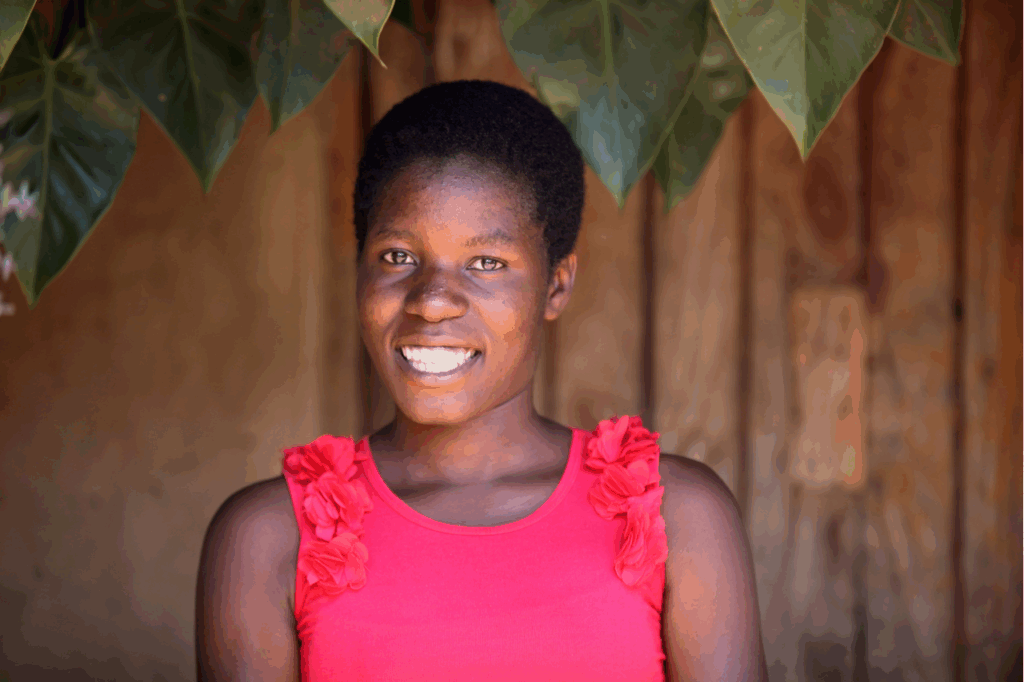
Asiya reclaims her future — With your support, more girls can too
When Asiya* was nine years old, her dream was simple: she wanted to learn to read and write. “If I can read, I can become someone,” she remembers. But one visit to her grandmother’s village changed the course of her life forever.
They arrived in the night, without warning. The silence of the village was shattered by gunfire and chaos. “We couldn’t run,” says Asiya. “Anyone who tried to run was shot dead.”
The village, which had once felt so safe, was turned into a battlefield overnight. In north-east Nigeria, such stories are tragically common. Since 2009, conflict has displaced more than 2.3 million people,1 tearing families apart and forcing children like Asiya into lives they never chose.
Asiya and her grandmother were both abducted by gunmen. That was the last time she saw the world she knew. Days later, her grandmother was released. “Too old,” the insurgents said. But Asiya, young and full of life, was held back.
Her father was inconsolable when he heard the news of her abduction. He followed every lead he knew of. He chased every rumour of insurgents nearby. But there was never any sign of her.
Eight years in captivity
Asiya spent eight years in captivity. During this time, she was forced to marry one of her abductors, Abdul*. When she became pregnant, something in Abdul* changed. Whether it was guilt or love, she’ll never know, but he did the unimaginable: He let her go.
Six months pregnant, Asiya walked day and night through dense undergrowth with Abdul for two days, with no food or water. All she had was fear and the will to survive. “I was so tired and hungry, but I kept walking,” she says.
Abdul stopped short of a military checkpoint. If he was caught, he would be shot. If the insurgents found him, they would shoot him. She begged him to come with her, but he refused. She walked on alone.
At the checkpoint, the soldiers took her to a camp in Maiduguri, Borno State. She was safe but lost. Her father had never stopped visiting the camp, hoping for news of his daughter. On that day, by luck or divine intervention, he came again and they were reunited. “I was so happy,” says Asiya. “With my family, I felt safe.”
But Asiya’s happiness was short-lived.
Her family was mired in poverty, and although heavily pregnant, she often went hungry. Some days, there was just one meal to share; other days, there was nothing at all. After her baby son was born, the hunger grew more intense.
Then a whisper of hope came from the village grapevine. Through the Magaji, the community leader’s wife, Asiya’s mother heard about Plan International’s Women-to-Women Support Group, a circle where women were taught how to care for themselves and their children.
That connection changed everything for Asiya. After being examined by Plan International’s healthcare workers, it was found that her child was severely malnourished. His arm measured just 9 cm on the mid-upper arm circumference (MUAC) band, so he was immediately moved to a stabilisation centre. He stayed there for three days, followed by eight weeks of outpatient care. Slowly, with each sachet of therapeutic food, he began to recover.
Asiya also received monthly cash support of ₦40,000 for six months – enough to buy food and medicine, and to provide peace of mind. “Now, I feel independent,” she says. ‘I can feed my child and I can even save a little. I’m not going hungry anymore.”
However, food wasn’t the only thing Asiya needed. Her fragile mind, worn down by years of trauma, needed care, and she was offered psychosocial support by the protection team. “I used to feel scared. I thought they would come back for me,” she says. “I felt lost. Like my senses were incomplete. But now, I feel whole.”
Asiya still has dreams for the future, they are just different now
With some financial stability thanks to the monthly cash support provided by Plan International, she is learning a trade and is determined to become a seamstress so that she can provide a better life for herself and her child.
Ní Saoirse go Saoirse na gcailíní
Your support helps girls like Asiya stay safe and in school and access the tools they need to succeed.